AI Is Causing Layoffs, Just Not in the Way You Think

AI isn’t replacing workers, yet
Since ChatGPT’s debut in 2022, we’ve wondered when, if ever, AI will replace humans in the workforce. Now, heading into 2026, we’re seeing the words “AI” and “layoffs” in the same headlines:
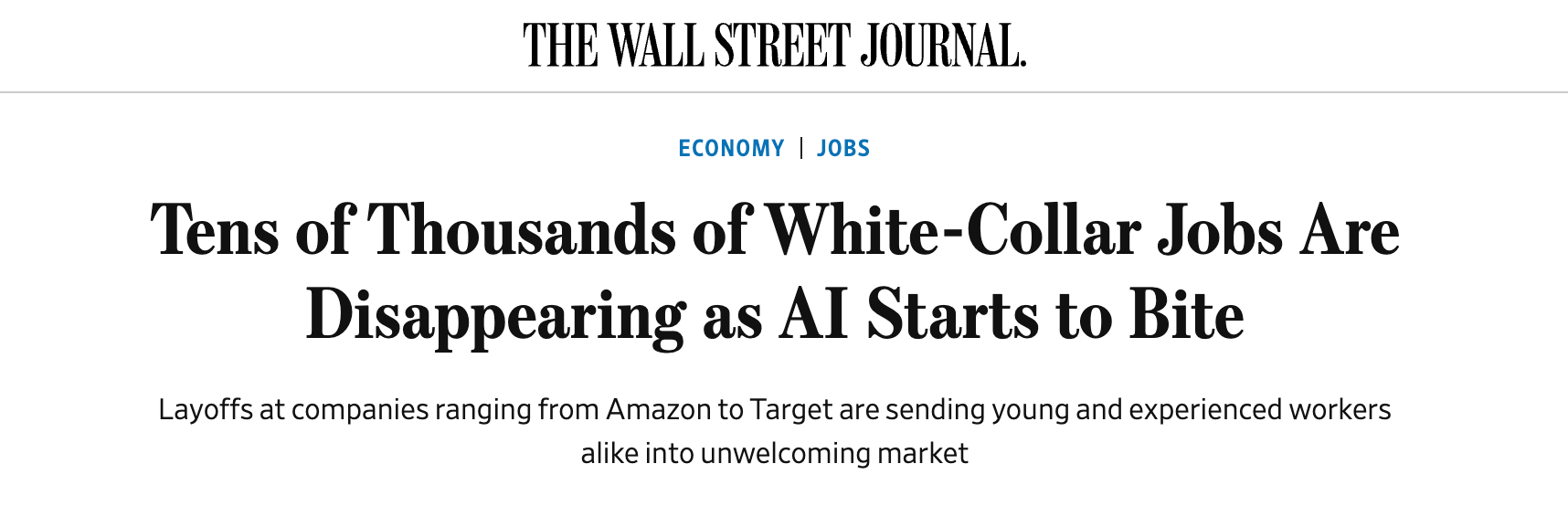
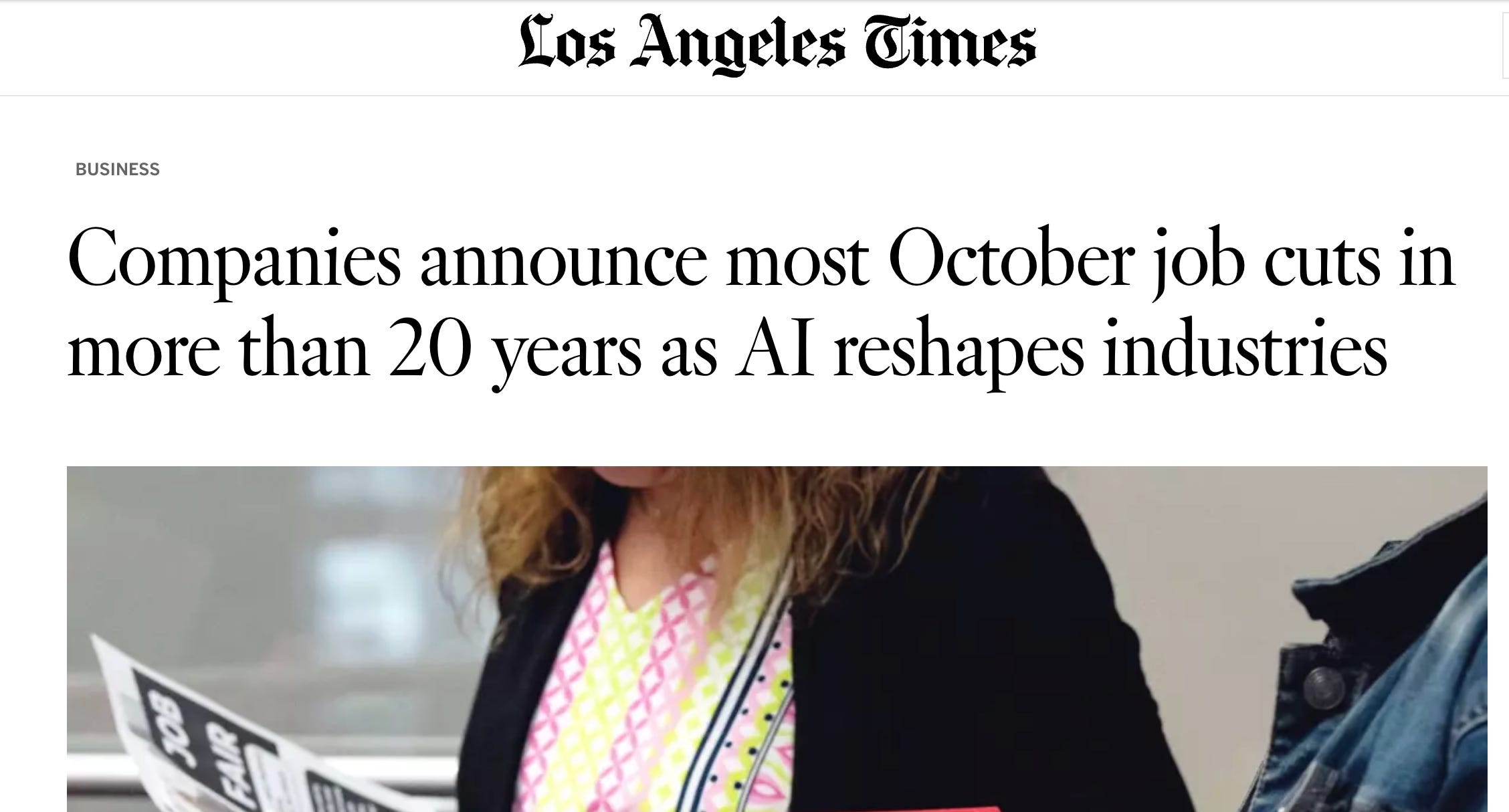
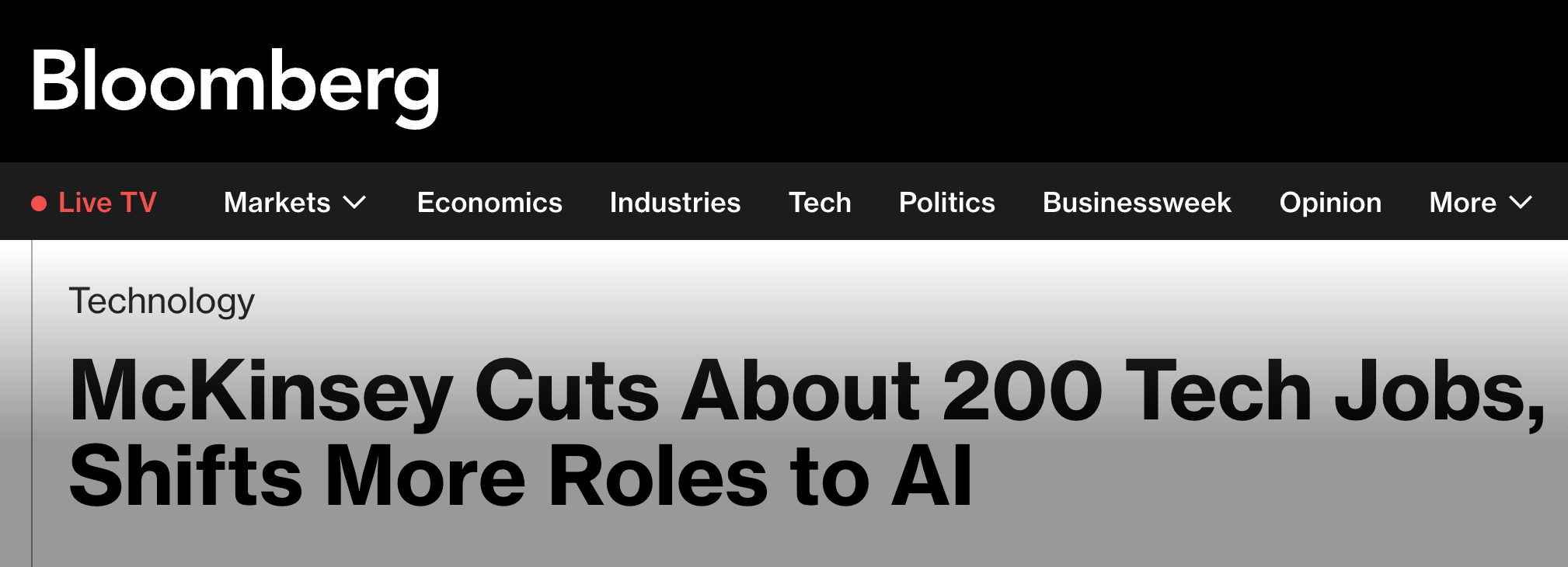
AI is playing a role in white-collar layoffs, but not because it can perform knowledge work better than people.
It’s not AI’s capabilities, but rather the narrative surrounding AI that is transforming everything. And because this narrative serves AI companies, non-AI companies and the media, a powerful feedback loop will continue to disrupt the economy.
What the data says
First, layoffs are happening at a high clip. Through November, Challenger, Gray & Christmas reported that 2025 had more layoffs than any year since 2020.
Still, according to that same report, less than 5% of the cuts cited “AI” as the reason. DOGE actions (25%), market conditions (21%), closing (19%) and restructuring (11%) were more common. Without more information, it’s hard to know how AI caused layoffs. What were the jobs, and how has AI replaced them? There is smoke here, but so far, no evidence of fire.
In an August 2025 report, Goldman Sachs economists had a measured take:
“To date, low adoption is limiting the overall labor-market impacts from AI, according to Goldman Sachs Research. Our economists found no significant statistical correlation between AI exposure and a host of economic measures, including job growth, unemployment rates, job finding rates, lay off rates, growth in weekly hours, or average hourly earnings growth.”
The Brookings Institution had a similar evaluation in an October 2025 report:
“Overall, the pace of labor market change following ChatGPT’s launch nearly three years ago appears consistent with historical trends. AI’s early stages look less like a revolution and more like a familiar, gradual evolution.”
What common sense says
You don’t need to be an economist to question the “AI is ready to replace us in the workforce” narrative. Look no further than OpenAI’s cash burn. According to the Wall Street Journal, OpenAI is going to burn through $9 Billion in 2025, even after generating $13 Billion in revenue. If they had really cracked the code of knowledge work, we’d expect to see far greater revenue, clear pricing power, or obvious labor displacement (we see none of these). Instead, OpenAI expects to increase their cash burn to $74 Billion in 2028. Maybe the payoff will be worth it in the end, but that level of cost implies there isn’t a transformation coming in the next year or two.
Looking at the incentives
So if the data and our own common sense don’t point to an AI labor revolution, why are so many people talking about AI and job loss together? The reason for this comes into focus when you look at who’s driving the conversation and their incentives.
AI labs
First, the major AI labs OpenAI and Anthropic (and their leaders), absolutely need this conversation to continue. Baked into their massive valuations, and their permission to burn billions of dollars, is the assumption that these technologies are extremely powerful, and will become more so as more money is invested.
They seed and perpetuate this narrative because it serves them. In a February 2025 essay, Sam Altman wrote:
“In some sense, AGI is just another tool in this ever-taller scaffolding of human progress we are building together. In another sense, it is the beginning of something for which it’s hard not to say “this time it’s different”; the economic growth in front of us looks astonishing, and we can now imagine a world where we cure all diseases, have much more time to enjoy with our families, and can fully realize our creative potential.”
This implies that the faster we build bigger data centers to train and run these models, the faster we can get to AGI and transform everything. Decades-long, incremental adoption of AI won’t be good enough for investors who are banking on something very big, very soon. The idea that AI is causing layoffs right now is a best case scenario for Sam Altman and his peers.
The media
The media plays an important role in telling this story. Journalists, podcasters, YouTubers want to keep their audiences engaged. Frankly, the real story is boring compared to the hype, and “boring” is anathema to most outlets. While traditional journalists rarely, if ever directly attribute layoffs to AI, the nuance gets lost in articles where the words “AI” and “layoffs” appear together multiple times.
Corporate execs
Finally, the story serves executives at non-AI companies. First, it provides cover for layoffs that probably would have happened anyway. Execs can avoid responsibility for over-hiring while business boomed coming out of the pandemic. Next, by mentioning AI as part of a layoff announcement, an executive looks smart. In a blog post about their October layoffs, Amazon combined a nod to AI and to efficiency:
“This generation of AI is the most transformative technology we’ve seen since the Internet, and it’s enabling companies to innovate much faster than ever before... we’re convinced that we need to be organized more leanly, with fewer layers and more ownership, to move as quickly as possible for our customers and business.”
They are not only “streamlining”, but also setting up their firm for the inevitable future of AI-everything. This has risks though, because eventually investors will want to see a return on AI initiatives. Absent real revenue growth, deeper cost cutting would be the only way to show that return.
Paradoxically, the longer AI goes without having an impact, the more it may be cited as a reason for layoffs. Execs could lay off more people just to show “the AI is working”.
What this means
Looking at the AI landscape, we see a technology with big potential, but not big results (yet). For now, AI is changing how layoffs are justified, long before it meaningfully replaces people in the workforce.